
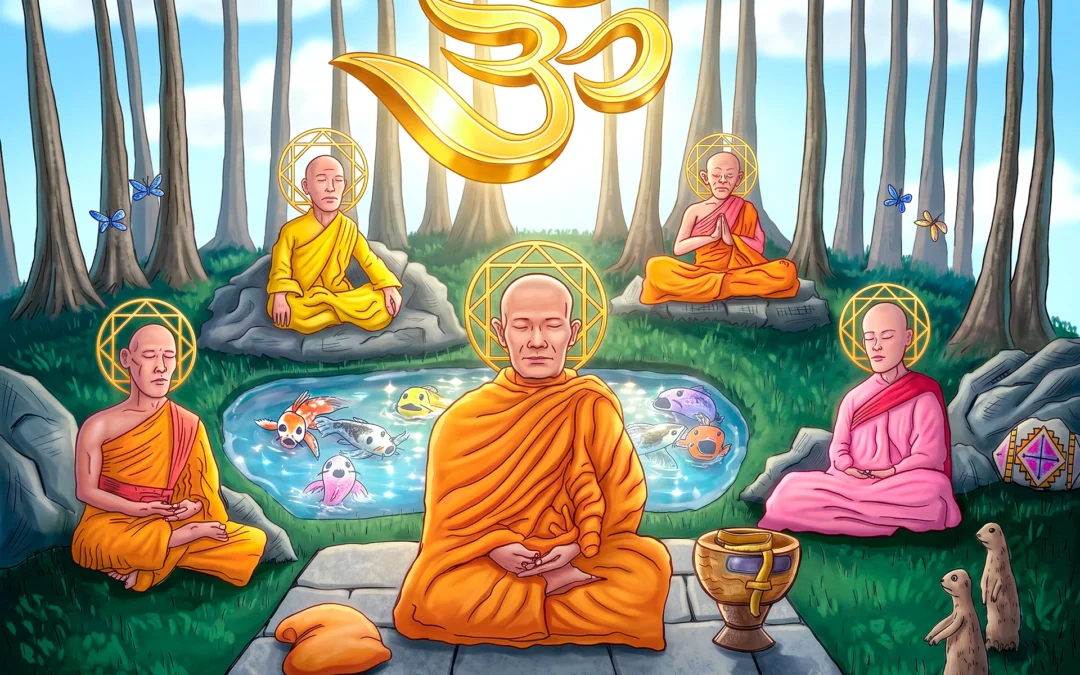
The Two Selves: Self‑Awareness, Self‑Consciousness, and the Modern Disturbance of the Mind
Introduction: The Split in the Modern Self
Human beings possess two distinct modes of inward attention: self‑awareness and self‑consciousness. Though they appear similar, they lead us down radically different paths. Self‑awareness nourishes clarity, presence, and spiritual awakening. Self‑consciousness breeds anxiety, distortion, and a sense of perpetual inadequacy. One is the illuminated version of the other — its shadow twin.
To understand how these two selves diverge, we must begin at the moment human consciousness first expanded beyond mere survival.
- Awakening Beyond Survival
Human consciousness emerged from the simple biological fact that we are more than our stomachs, teeth, and instincts. Once our basic needs are met, we gain the extraordinary ability to reflect, imagine, and shape the world around us — a movement often described as the shift from survival toward meaning.
With this awakening comes a new kind of perception — the ability to contemplate our existence, our potential, and our place in the natural order. But it also introduces a vulnerability: the capacity to become alienated from that very order.
That alienation begins when we step out of nature’s rhythms and into the artificial world we have built around ourselves.
- The Unnatural World and the Birth of Self‑Consciousness
As we construct increasingly artificial environments, we drift from nature’s rhythms and enter a realm governed by human standards — appearance, status, possessions, and performance. In this realm, self‑consciousness takes root.
From early childhood, we absorb the message that something about us is flawed or insufficient. We measure ourselves against idealized images and internalize the gap as personal failure.
This perceived shortcoming becomes a point of manipulation. When we fear we do not “fit,” we become susceptible to external pressures, social expectations, and the influence of others. Anxiety grows, and our inner world begins to destabilize.
To understand the scale of this destabilization, imagine the mind not as an abstract concept but as a landscape — a body of water shaped by the forces around it.
III. The Disturbed Lake: A Metaphor for the Modern Mind
Imagine the soul as a deep, still lake. In nature, disturbances occur — wind, rain, seasonal changes — but they come in cycles, allowing the waters to settle. We adapt, strengthen, and remain upright.
The modern world, however, introduces disturbances that stack unnaturally: constant evaluation, relentless comparison, digital noise, and social pressure. These accumulate like glaciers cracking and falling into the lake, creating storms too frequent and too violent for the mind to recover from.
This is the essence of chronic stress — the body and mind overwhelmed not by nature’s challenges but by artificial ones.
When these storms become constant, anxiety ceases to be an individual struggle and becomes a collective condition.
- The Social Disease of Anxiety
The anxiety born from self‑consciousness is not a personal failing; it is a social disease. It emerges when the human mind — evolved for small communities and natural rhythms — is placed inside a world of constant evaluation and artificial expectations.
Today, several forces intensify this pressure. The endless news cycle has become a kind of secular liturgy — a daily ritual of alarm delivered by anchors who speak in the cadence of prophets but with the urgency of carnival barkers. Influencer culture functions like a digital priesthood, dispensing commandments from ring lights and sponsored skincare. Cryptocurrency speculation widens wealth disparities, leaving underserved communities feeling further excluded from opportunity. And when elected officials treat public responsibility as performance art, it signals that accountability is optional — a message that trickles downward and erodes collective stability.
Each of these forces contributes to rising internal load. Unlike natural stressors, which come in cycles and allow recovery, these artificial pressures stack continuously. They keep the inner lake of the mind in a state of agitation, never still long enough to reflect anything clearly.
This is why anxiety feels so pervasive today. It is not merely an emotional state but a cultural condition — a shared disturbance of the inner waters.
Yet even in this collective turbulence, stillness remains possible. The lake can be calmed — but only by turning inward, away from the noise, and toward awareness.
This is where the remedy begins: with the simplest act available to us, the breath.
- The Remedy: Returning to Awareness
Healing begins with slowing the internal dialogue — reducing the volume of self‑judgment until it becomes a whisper, then silence.
The mechanism is simple: the breath.
By becoming aware of breathing and nothing else, we shift from being the thinker to being the one who is breathed. Thoughts continue to arise, but they pass through without disturbing the waters. Slow, conscious breathing activates the parasympathetic nervous system and reduces anxiety.
To maintain this state, we use a beacon — a candle flame, the sound of running water, sunlight reflecting off a surface. These anchors prevent the mind from drifting back into rumination and help stabilize awareness.
And once the waters begin to settle, something remarkable becomes possible: we can finally see what lies beneath the surface — the hidden colors formed under pressure.
- When the Glacier Breaks: Hidden Colors Within the Self
A recent Himalayan disaster offers a striking parallel to the inner life. In Nepal, part of a glacier fractured, triggering a destructive flood that swept through a village. Amid the devastation, something unexpected appeared: the broken ice revealed deep bands of blue and teal — colors formed over centuries of compression, invisible until the glacier cracked open.
This phenomenon mirrors what happens within us.
Under the pressures of life, layers of our inner self compress and disappear from view. Expectations, anxieties, and self‑consciousness harden around us like ice. When a rupture finally occurs — through crisis, awakening, or honest self‑examination — we often fear only destruction. But breaking open can reveal hidden strata: strengths, insights, and inner beauty shaped quietly over years.
Just as the glacier’s collapse exposed colors forged by time and force, our own moments of fracture can uncover qualities formed in silence — resilience, compassion, clarity, and the deep hues of our authentic self.
This is the paradox of awakening: the same forces that disturb the lake can also reveal the gems resting at its depths.
Conclusion: Reclaiming the Stillness of the Inner Lake
Self‑awareness is our natural state — the clear, calm lake. Self‑consciousness is the storm created by an artificial world. When we learn to quiet the inner dialogue, accept our imperfections, and return to the breath, the waters settle. We regain the ability to navigate our lives with clarity and purpose.
And perhaps this is the quiet mission of satire itself — not to mock the world, but to reveal its fractures, its pressures, and the hidden colors waiting beneath them.
The path is not easy, but it is simple: awareness over evaluation, presence over performance, stillness over turbulence.
For Further Reading
For readers interested in the psychological and philosophical foundations behind the ideas explored above, I recommend:
Maslow’s Hierarchy of Needs Abraham Maslow, “A Theory of Human Motivation,” Psychological Review (1943).
Self‑Discrepancy Theory</summary> E. Tory Higgins, “Self‑Discrepancy: A Theory Relating Self and Affect,” Psychological Review (1987).
Social Comparison Processes Leon Festinger, “A Theory of Social Comparison Processes,” Human Relations (1954).
Allostatic Load and Stress Physiology Bruce McEwen, “Protective and Damaging Effects of Stress Mediators,” New England Journal of Medicine (1998).
Mindfulness-Based Stress Reduction Jon Kabat‑Zinn, foundational work on MBSR and “Full Catastrophe Living” (1990).